
EU Member States set 2040 climate target – but is the Union on track for 2030 in the energy sector?
An outlook on EU investment needs for the energy transition and the EU’s 2040 climate target.
Authors: Clara Calipel, Caroline Henry, I4CE – Institute for Climate Economics
Just before the start of COP30 in Belém, EU Member States agreed to reduce net greenhouse gas emissions by 90% in 2040 compared to 1990 levels, including a 5% flexibility through international carbon credits.
While this target provides medium-term visibility, a first milestone for 2030 is currently ahead. By then, Member are expected to reduce their emissions by 55% compared to 1990 levels. With only five years remaining, it is worth assessing whether the current pace of climate-related investment is sufficient to achieve the EU’s 2030 targets.
In its latest report, The State of Europe’s climate investment [1], I4CE tracks climate investments and the associated investment needs in relation to the EU’s 2030 targets. This analysis includes, among others[2], the energy production sector, its transport and storage, and the production of clean technologies.
1. After several years of growth, climate-related investments in the energy sector are slowing down in 2024, while the EU remains far from meeting its 2030 climate targets
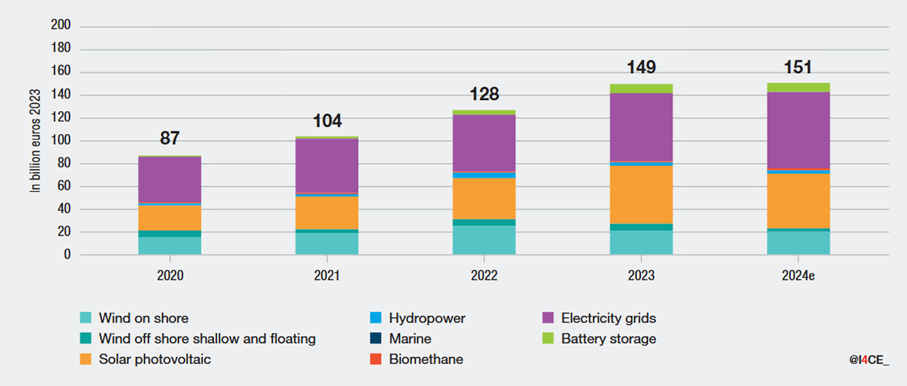
The energy sector has demonstrated strong momentum in climate investment over the past few years, reaching 149 billion euros in 2023, a 17% increase compared to 2022. Climate investment growth was mainly driven by rising investments in solar PV and power grids, while investment in onshore and offshore wind continue to decline in 2023. The growth in energy related climate investment observed since 2020 is at risk of being reversed in 2024, as climate investments are expected to have stagnated at best in 2024.
Figure 1: Climate investment in the energy sector has increased significantly in recent years, driven by substantial growth in solar PV and power grids.
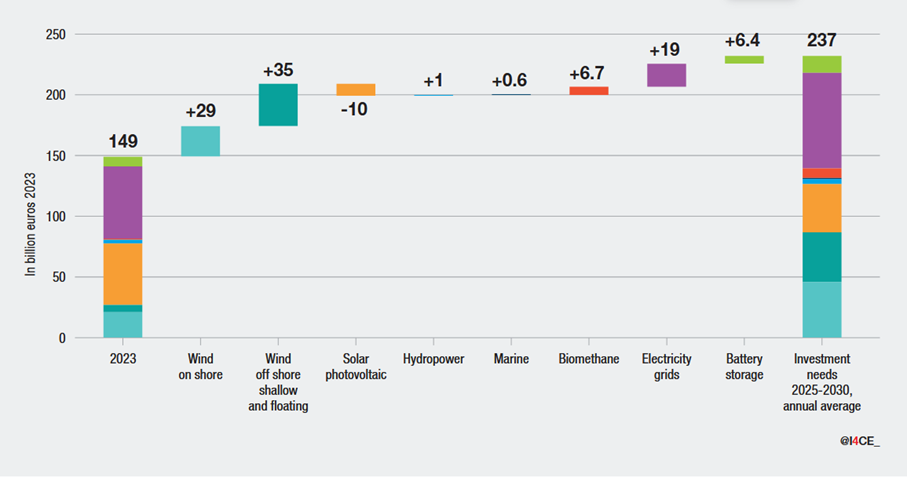
Yet, significant efforts remain to be made to achieve the 2030 targets, as the current climate investment deficit amounts to 83 billion euros for the energy sector. The wind sector shows the largest investment deficit, at 64 billion euros. Solar PV, by contrast, shows an investment surplus of 10 billion euros, driven by a recent surge in solar installations that has put the EU on track to meet its sectoral targets.
Figure 2: The energy climate investment deficit is estimated at 87 billion euros in 2023.
2. EU cleantech manufacturing is expanding, but weak demand and global competition put future capacities at risk
In 2023, 13.9 billion euros were invested in cleantech manufacturing across the EU[3]. To reach the indicative targets set by the European Commission in the Net Zero Industry Act (NZIA) for these specific sectors, 4.6 billion euros would be needed annually between 2025 and 2030. The current investment surplus is primarily attributable to battery manufacturing capacities already under construction exceeding the capacity targets set by the European Commission.
Despite progress in scaling up manufacturing capacities, underused capacity and factory closures in solar, battery and heat pumps show the strain of global competition and weak local demand. 50% of existing and planned batteries manufacturing capacities are at risk of being delayed or cancelled by 2030.
3. Planning climate investments to meet the 2030 target is fundamental
Based on this assessment, if investment does not accelerate, the EU risks missing its 2030 target. It is therefore crucial to establish an investment framework that should include a clear public-private financing strategy for climate, strategic autonomy, and competitiveness. Developed jointly by the EU and its Member States, this strategy should clarify the roles of public and private finance, using policy tools like fiscal levers, de-risking mechanisms, and regulation. It will provide predictability for private actors to plan effectively and ensure the investment gap is closed on time.
*The views expressed in this piece are those of the authors alone and do not necessarily reflect the views of the INETTT Secretariat or the wider INETTT membership.
[1] Calipel, C. Henry, C. Cornaggia, A. I4CE. (2025). The State of Europe’s Climate Investment, 2025 edition.
[2] Outside energy and clean technologies manufacturing, the other sectors analysed in the report include buildings and transport.
[3] The analysis includes wind turbines, solar panels, batteries, heat pumps and electrolysers.