
COP30 climate finance outcomes
Where do we stand on financing the energy transition?
Authors: Diana Cardenas Monar and Louise Kessler, I4CE – Institute for Climate Economics
In November 2025, COP30 concluded in Belém with all parties agreeing on a “global mobilization” (or mutirão) against climate change, proving that multilateralism remains a viable path for action, despite strong geopolitical and economic headwinds. However, Belém delivered underwhelming results on several fronts, and particularly as no roadmap to transition away from fossil fuels was adopted despite a powerful push from over 80 countries.
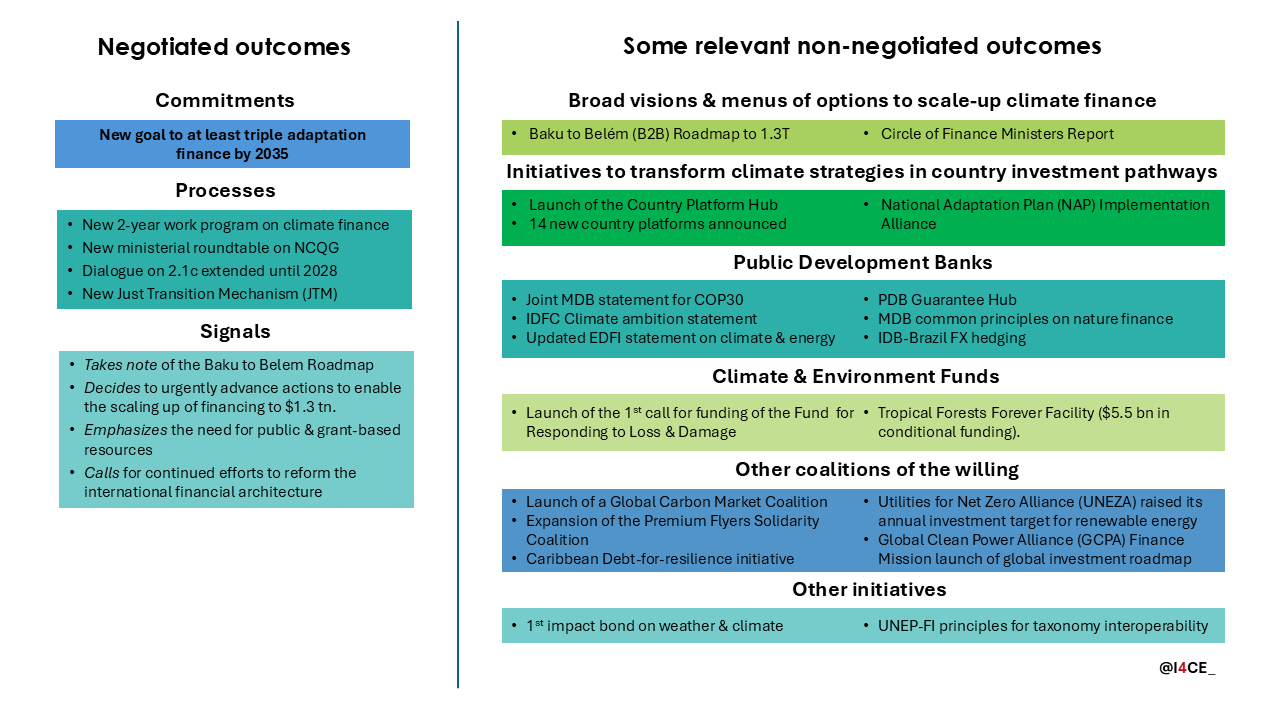
On climate finance, COP30 outcomes reflect a contrasted picture that shows that the implementation path may lie outside the negotiation rooms. On the one hand, official negotiations failed to shift from ambition to implementation. Despite having agreed on a New Collective Quantified Goal (NCQG) last year and commendable efforts with innovative formats proposed by the Brazilian presidency, discussions quickly drifted back to an entrenched battle on yet another headline quantitative target –this time on the new goal on adaptation finance. On the other hand, Belém registered interesting progress on many non-negotiated outcomes: from broad visions and menus of solutions to initiatives to transform climate strategies in country investment pathways, from public development banks (PDBs) to vertical climate funds and coalitions of the willing. Figure 1 below provides a broad picture of relevant negotiated and non-negotiated outcomes on climate finance.
Figure 1. COP30’s main negotiated and non-negotiated outcomes on climate finance
Negotiated outcomes were disappointing, and particularly on climate finance
Negotiations on climate finance rapidly returned to familiar bloc-against-bloc rhetorics, mainly around the new goal to triple adaptation finance by 2035. On the one hand, developing countries focused on Article 9.1 –under which developed parties have an obligation to provide climate finance to developing ones– and called for a new USD 120 billion target for adaptation by 2030, which ended up being adopted with a less ambitious timeframe and no specific target. On the other hand, developed countries stressed the need to expand the donor-base, to stay within the framework of the NCQG and to match any new commitments on adaptation finance with increased ambition on mitigation efforts, including through stronger domestic policies and private-sector mobilisation.
A central outcome for just transitions was the decision under the United Arab Emirates Just Transition Work Programme to establish a new Just Transition Mechanism (JTM). The JTM is intended to provide a framework for international cooperation on just transition pathways, recognising that means of implementation –including capacity-building, climate finance and technology transfer– are essential for developing countries to pursue just and equitable transitions that leave no one behind. While the mechanism was widely hailed by civil-society coalitions as one of the strongest rights-based outcomes of COP30, negotiations failed to attach dedicated finance or a clear operational roadmap to it, leaving the task to follow-up processes and coalitions of the willing.
But COP30 missed the opportunity to substantively discuss all or even part of the 75 concrete measures to scale up climate finance for developing countries listed in the Baku to Belem (B2B) Roadmap (further detailed below). Even if the Global Mutirão “decides” –the strongest possible verb in negotiations– “to urgently advance actions to enable the scaling up of financing” for developing countries, it merely “takes note” of the B2B Roadmap and establishes yet another set of processes which should now be strategically used as a platform to discuss and advance the implementation of the $300 billion goal and the NCQG as a whole, as well as definitions on Art. 2.1c of the Paris Agreement.
Yet non-negotiated outcomes show progress can take shape outside negotiations rooms
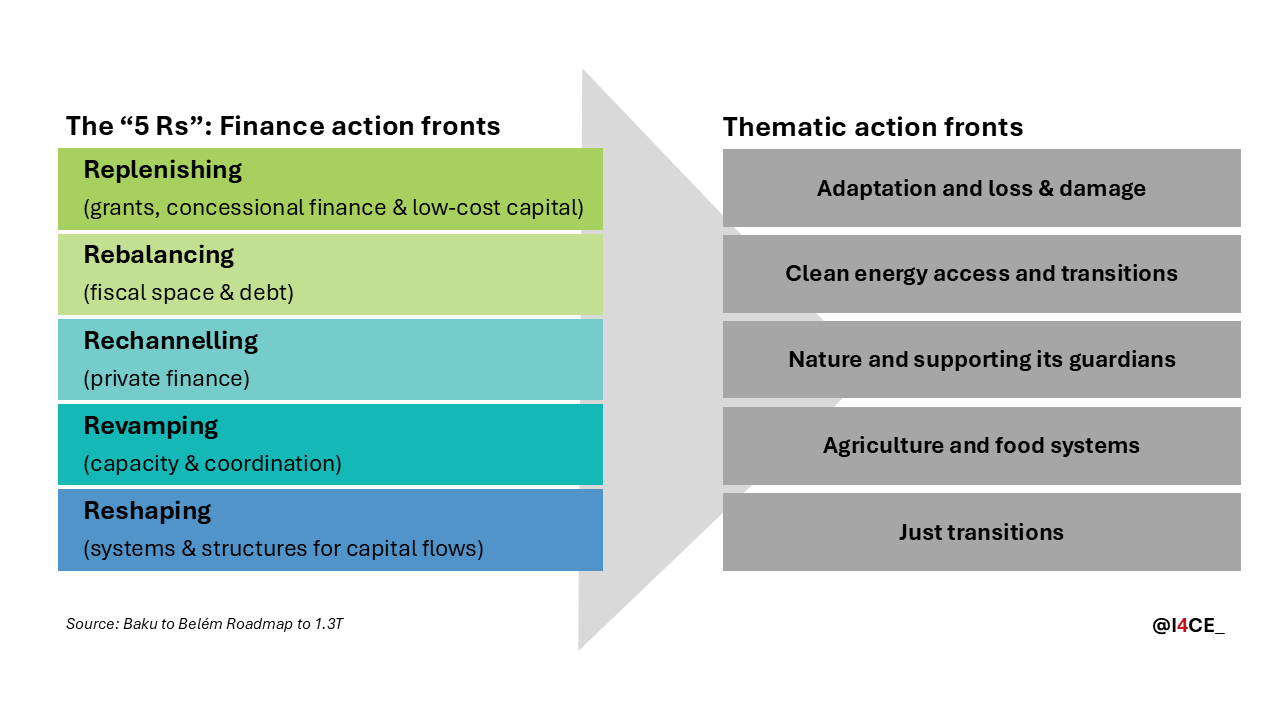
Belém’s first positive legacy on the non-negotiated climate finance outcomes is the Baku to Belém (B2B) Roadmap to 1.3T and the report of the COP30 Circle of Finance Ministers (CoFM). Together, these important documents provide a comprehensive menu of solutions, with dozens of concrete measures and recommendations addressing a wide spectrum of issues related to scaling up climate finance, including among its action fronts financing clean energy access, green industrialisation and just transitions, as illustrated in figure 2 below. The B2B Roadmap was meant to operationalise the NCQG’s call to scale up external finance for developing countries to at least USD 1.3 trillion per year by 2035. Drawing on estimates from the Independent High-Level Expert Group (IHLEG), it recalls that by 2035 developing countries will require around USD 3.2 trillion a year in climate –and nature-related investments, of which the largest share –about USD 2.05 trillion annually – is the clean energy transition, while just transition spending would need to rise from USD 10 billion to USD 50 billion per year.
Figure 2: Breakdown of the B2B roadmap recommendations, by finance and thematic action fronts
The Circle of Finance Ministers is, in itself, another major outcome. This sui generis and rather heterogeneous group of 35 finance ministries was brought together by the Brazilian presidency to provide inputs for the B2B Roadmap. Its final report is organized around five strategic priorities: (1) scaling up concessional finance and optimizing climate funds; (2) reforming multilateral development banks (MDBs) to scale up sustainable finance; (3) boosting domestic capacity and investment frameworks for climate finance, including through country platforms; (4) developing scalable and innovative financial solutions for private capital mobilization; and (5) strengthening regulatory approaches for climate finance.
COP30 also built momentum around national financing plans or initiatives aiming to transform climate strategies in country investment pathways –in line with recommendations from the B2B roadmap and the publication of the third generation of NDCs. In partnership with the Green Climate Fund (GCF), 13 countries and one regional coalition announced plans to establish new “country platforms” under the GCF Readiness Programme, including Cambodia, Colombia, the Dominican Republic, India, Kazakhstan, Lesotho, Mongolia, Nigeria, Oman, Panama, Rwanda, South Africa and Togo, and a regional platform of African Island States Climate Commission member countries. These platforms are framed as mechanisms to move from fragmented projects to coherent investment architectures, turning national priorities into investable pipelines, including investment packages for the energy transition and long-term decarbonisation (e.g. Kazakhstan’s platform to support energy-transition investment packages on the way to carbon neutrality by 2060; in Lesotho, a Just Energy Transition fund being structured under the platform).
In addition, the Country Platform Hub (CP Hub) was launched as part of COP30’s Solutions Acceleration Plan to connect and support national efforts to design and operationalise country platforms. The CP Hub aims to serve as a coordination mechanism linking countries to technical assistance, knowledge and finance, ensuring that global support systems respond effectively to country needs. The Hub builds on partnerships among key global initiatives –including the GCF, NDC Partnership, Climate Vulnerable Forum (CVF) and V20 Group of Finance Ministers, Finance in Common (FiCS), the United Nations Development Programme (UNDP) and the Global Capacity-Building Coalition (GCBC)– and anchors coordination in ministerial networks such as the COP30 CoFM, the Coalition of Finance Ministers for Climate Action and the CVF–V20. It will be guided by a Steering Committee with a majority of developing-country representatives and supported during its incubation by a light Secretariat hosted at the Africa Climate Foundation, with seed funding of almost USD 4 million to finance early activities on governance, coordination and knowledge systems, as well as a “Spark Plug” window to back early-stage platform design.
Belém also showed that coalitions of the willing can deliver progress towards a just energy transition and its financing when consensus-based negotiation fails. On fossil fuels, there was a coordinated effort by more than 80 countries to include a roadmap on transitioning away in the COP decision. While not included in the last version of the “Global mutirão”, this led the Netherlands and Colombia to announce the organization of a First International Conference for the Phase-Out of Fossil Fuels in April 2026. On finance, several initiatives are worth highlighting:
Multilateral development banks (MDBs) reaffirmed their commitments through a new joint MDB Statement for COP30, the International Development Finance Club (IDFC) –a coalition of 27 development bank– issued a new climate ambition statement confirming its commitment to finance the “progressive transition away from fossil fuels”, and European development finance institutions pledged to raise the share of climate finance in their portfolios from 30% today to 40% by 2030.
The Utilities for Net Zero Alliance (UNEZA) raised its annual investment target for renewable energy transmission and storage from USD 117 billion to USD 148 billion per year.
The Global Clean Power Alliance (GCPA) Finance Mission, co-led by the UK and Brazil, launched a global energy investment planning roadmap and action plans to scale private finance for clean-energy transitions in emerging markets and developing economies.
The Belém Declaration on Global Green Industrialisation –supported by 35 countries– links the energy transition to green industrial strategies, supply-chain partnerships and investment in clean manufacturing, explicitly seeking to balance decarbonisation with opportunities for job-creating industrial development.
The Global Solidarity Levies Task Force showcased the growing “Premium Flyers Solidarity Coalition”, building on a group of eight pioneer countries that committed earlier in 2025 to introduce levies on premium air travel and private jets, with revenues earmarked for fair transitions and resilience. These levies could, if implemented at scale and with revenues raised put to good use and transparently linked to measurable outcomes, play a catalytic role in bridging the climate-development finance gap providing predictable, debt-free resources.
In a nutshell…
COP30 concluded in Belém with outcomes on climate finance showing that while negotiations still stumble over old divides, real progress is taking shape outside the formal process. COP30 –and especially the preparatory work undertaken by the Brazilian presidency– offered a blueprint for how implementation can accelerate when coalitions of the willing choose to act. The challenge now is to turn this momentum into a durable architecture that delivers predictable, scalable finance, not more headline battles. If Türkiye and Australia seize this opportunity at COP31, Belém could yet be remembered not for what it failed to agree, but for what it set in motion.
*The views expressed in this piece are those of the authors alone and do not necessarily reflect the views of the INETTT Secretariat or the wider INETTT membership.